AKAYUKI Poise System: Draw-Cut Costs and Recovery
What poise costs in AKAYUKI: the documented 40-poise Iai draw-cut, the 40% restore from an Iai kill, the dual-wield blood flick, and how to spend poise in duels.
FAQ
What is poise in AKAYUKI?
How much poise does an Iai draw-cut cost?
How do I get poise back quickly?
What happens when poise runs out?
Poise is the quiet system behind every katana duel in AKAYUKI: Steel Blossoms Red. It is what stops the game from being a click race, and it is the reason two players with identical blades get different results.
The documented numbers
Under version 1.3.11:
| Action | Poise effect |
|---|---|
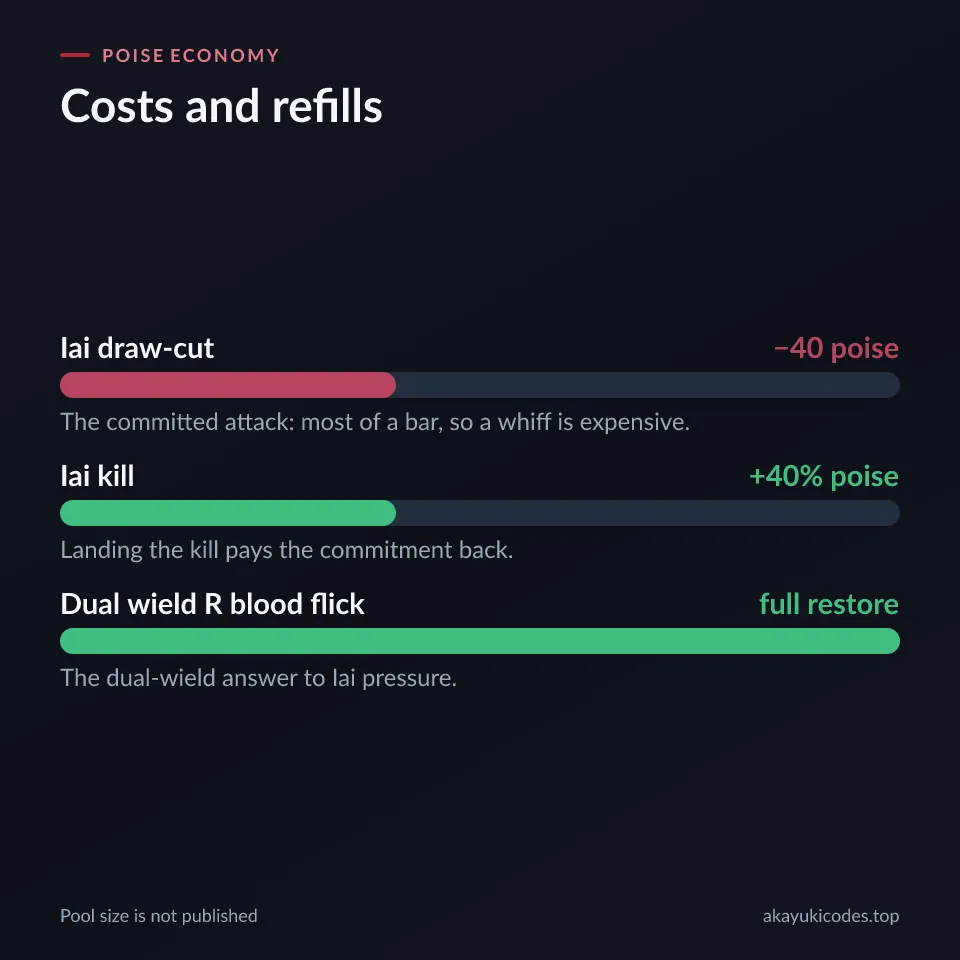
| Iai draw-cut | Costs 40 poise |
| Iai kill | Restores 40% poise |
| Dual wield: R blood flick | Fully restores poise |
These are the only published poise values for the game so far. The total poise pool is not documented publicly, so treat 40 as a meaningful fraction rather than a fixed count of swings — you will feel the bar rather than compute it.
Why the draw-cut is a double-edged attack
The Iai draw-cut is the most committed strike in the kit:
- It costs a large chunk of poise.
- If it lands a kill it gives back 40% — a good trade.
- If it misses, it can be parried, and you are down the poise with nothing to show.
That is the entire risk profile of Iai. Its faster draw and longer dash make the first strike easy to land, and its missed draw-cut makes you easier to punish than a dual-wield guard ever is.
Dual wield trades burst for safety
The dual-wield answer is the R blood flick, which restores poise fully. Paired with the still guard that parries incoming draw-cuts, dual wield becomes the style that wins exchanges by refusing to over-commit.
The cost is pressure: two blades that swing together are slower to convert a gap into a kill than a dash-driven draw-cut. You win by making the Iai player miss, then punishing.
A practical poise discipline
- Do not chain draw-cuts. One clean commit, then read the fight.
- Use kills to reset. A kill gives 40% back; a kill streak keeps you functional.
- Treat a missed draw-cut as a defence problem. Get the guard up or back off, because you are at your weakest immediately after.
- Recover deliberately. If you are out of poise and the opponent is not, disengage instead of trading.
How poise fits the rest of combat
Poise only matters because attacks matter. If you are still learning the input grammar, the controls guide comes first — a slash performed the wrong way can miss while still costing you. The blade you carry changes your poise economy too, which is why Iai versus dual wield is worth reading next.
After that, PvP duels are where poise decisions become visible, because the first-to-three-kills format punishes anyone who spends their bar on the first exchange.
What is not published
There is no public table of poise costs for every action, no max-poise figure per character, and no source confirming whether family-name stats change poise. Where this page says “documented”, it means a value appeared in a published source with a version attached. Anything beyond that would be invention.
Related Articles
combat
AKAYUKI PvP Guide: Duels, Lock-On and Rematches
How AKAYUKI PvP works: first-to-three-kills duels, lock-on with Q, reading the kill feed, handling flanks, and why a severed limb is not a kill.
guides
AKAYUKI Controls: Katana Inputs, Iai and Dual Wield
Every AKAYUKI control that matters in a fight: equipping a katana, swiping a slash, lock-on, the in-game menu, mouse sensitivity, and how Iai and dual wield differ.
weapons
AKAYUKI Katanas: Iai vs Dual Wield and Code Skins
Compare the two AKAYUKI katana styles — Iai draw-cuts versus dual wield — plus the Discombobulate and Communiblade skins you can claim from codes.
Was this helpful?
Thanks for the feedback!